
Civilisation's Odyssey
Odysseus returned to a home that had changed. Humanity must create a home that has never yet existed.

Christopher Nolan’s The Odyssey is very good, hugely enjoyable and ‘reassuring that Hollywood still has some artistry and ambition left in it’, as Maren Thom correctly argues. But in the manner of Hollywood epics, it’s not entirely Homer. At moments Odysseus becomes Jason Bourne in a bronze helmet: a hero who does not want to be a hero. Homer’s Odysseus is more complicated, unsettling, cunning, vain, resourceful, brutal and hungry for recognition as well as home.
Still, Nolan’s production sparked my imagination and made me think less about the monsters, storms and temptations than about the shape of the journey I have been exploring in What a Piece of Work is Man! from the get-go.
This is not a mythical journey but the real story of mankind forced to confront uncertainty and survive through courage, intelligence, and artifice. Battered by nature, obstructed by invented gods, betrayed by companions, self-doubt and egotism, mankind continues regardless because there is no choice and somewhere beyond the sea lies its Ithaca.
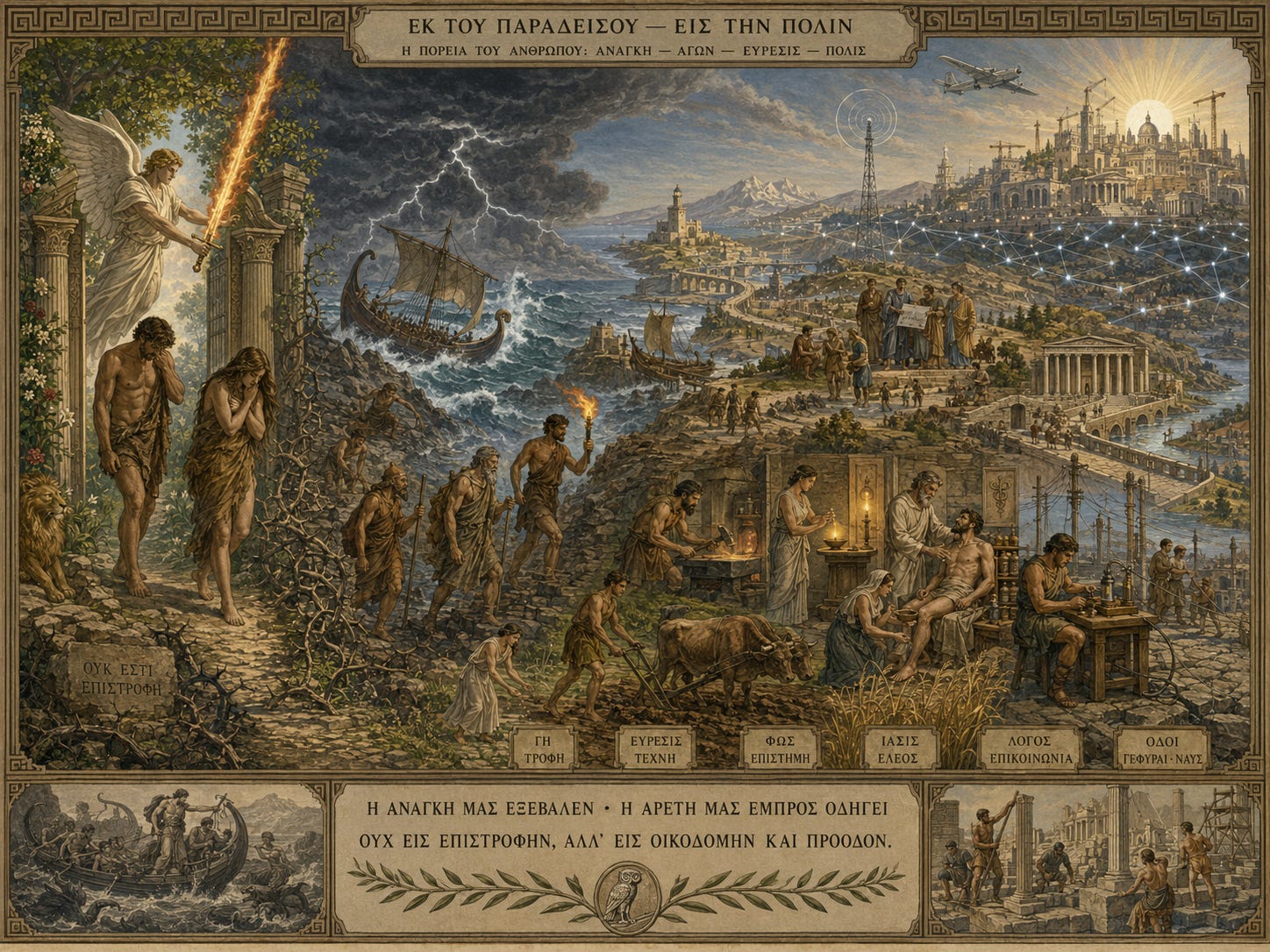
There is a great parallel between Odysseus’s journey and mankind’s expulsion from the Garden of Eden.
The expulsion from Eden is usually read only as a Fall. It is the loss of innocence, abundance and the assurance of and intimacy with God. But the Fall can also be read as a departure: the beginning of mankind’s long journey through necessity, uncertainty and invention.
Yet there is one decisive difference. Mankind, like Odysseus, is cast into a world of danger, temptation, suffering and death and survives through intelligence, courage and artifice. But Odysseus struggles to return to the home he has lost. Adam and Eve cannot return. The cherubim and the flaming sword bar the road back to innocence.
Odysseus’s Ithaca lies behind him. Mankind’s Ithaca must still be built.
The first departure
The parallel begins with exile from a protected world. Odysseus leaves Ithaca and spends years exposed to forces he cannot command. Adam and Eve leave a garden in which the conditions of life have been given and enter a world in which those conditions must be produced. Yet there is an important qualification. In Eden, man is placed in the garden ‘to work it and keep it’. Work is not the punishment. Cultivation, care and making belong to the human vocation before the Fall. What comes afterwards is toil: now work is performed under the pressure of necessity, against a resistant world and under the shadow of hunger, pain and death.
Eden is therefore not a resort in which man waits permanently for fruit to fall into his mouth. It is a garden, already a meeting of nature and cultivation. What its inhabitants do not yet experience is the tyranny of survival, equipped as they are with only the biological limits nature has imposed upon them as a species.
After the Fall, this tyranny becomes life’s basic condition. Yet Genesis moves swiftly from expulsion to the beginnings of civilisation: Cain builds a city, and his descendants keep livestock, make music and work metal. The book that describes the curse of toil also records humanity’s answer to it. The Fall subjects mankind to necessity, but the struggle against necessity develops the capacities to overcome it. Exposure produces knowledge – the outcome of human imagination and intelligence.
Civilisation begins as mankind’s answer to exile.
Human exile and Odysseus’s journey share striking parallels. Odysseus survives because he can think around obstacles. He improvises, disguises himself, builds, navigates and waits. The gods remain capricious, yet uncertainty never abolishes responsibility. The civilising journey of mankind is likewise beset by unpredictability and a lack of control over nature. Humanity must act in conditions it did not choose. Yet the journey represents the gradual accumulation of capacities and understanding for responding to ambiguity and confusion. Like the Odyssey, humanity’s journey shows that fate may set the conditions, but human rationality and judgement remain fundamental to overcoming them.
Ithaca behind and Ithaca ahead
The divergence between the two stories is important but not decisive. Odysseus has a destination that already exists. Mankind must construct its destination while travelling towards it. Yet Odysseus does not return to a home unchanged during his absence.
Indeed, twenty years have passed. His mother is dead, his father has withdrawn into grief, his infant son has grown into a man, and Penelope has defended the household against the suitors. Ithaca remains in the same place, but home cannot be recovered merely by stepping ashore. Odysseus must discover who remained faithful, master his anger, and prove himself to Penelope. The house must once again become a home.
The marriage bed, through which Penelope finally recognises him, is one of the poem’s most suggestive images and carries enormous symbolic importance, especially for mankind’s civilisational journey: Odysseus built the bed around the trunk of a living olive tree. The bed is rooted in nature yet shaped by human craft. He neither destroys the tree nor leaves it untouched. He incorporates it into a dwelling. In miniature, Homer reveals how Greek civilisation understood, cultivated, and made nature part of the human world, and thus of human meaning. The tree continues to live, but it now supports a home – a relationship between man and nature that remains and will always remain the foundation of all human existence.
The Odyssey is even more remarkable for its humanism. When Calypso offers Odysseus immortality and release from ordinary human necessity – a path of indolence and hedonism – he chooses the dangerous prospect of returning to Ithaca instead. He immediately acknowledges that another god may strike him down at sea yet insists that he will endure whatever comes. Odysseus does not believe the future will be easy. (Strapping yourself to a few planks and setting out to sea is hardly the actions of a passenger expecting room service while on board). But he believes there is a future worth enduring hardship for. He chooses mortal life, historical time and an uncertain homecoming over Calypso’s static paradise.
Hope here is not confidence that nothing bad will happen. It is confidence in his capacity to respond when it does.
Odysseus returns, then, not to the past but with the knowledge of the journey and his own agency. His homecoming is real, but it takes place in different circumstances. Ithaca is no longer merely where he began. It is the place he must inhabit with everything he has learned about uncertainty, pride, restraint, loyalty and power.
Mankind’s journey has the same structure, but on a civilisational scale. We cannot go back to Eden, and nor should we wish to discard the knowledge acquired East of it. Our task is to make a home that preserves what was valuable in the Garden – freedom from necessity – while incorporating what has been gained through history, knowledge, responsibility and conscious human agency.
Turning limits into problems
That is what mankind’s journey has been about for thousands of years. East of Eden, the soil yielded thorns, so mankind developed agriculture, irrigation, tools, fertilisers, preservation and refrigeration. Darkness fell, so we made fire, candles, gaslight and electricity. Bodies became diseased, so we developed sanitation, surgery, antibiotics and vaccines. Distance separated us, so we built roads, ships, railways, aircraft and communications networks. Individual memories fail, so we created writing, libraries, printing presses, computers and the internet.
Each of these achievements alters the boundary between necessity and possibility. None abolishes nature. Agriculture does not abolish the seasons. Medicine does not abolish mortality. Engineering does not repeal gravity, heat or distance. Mastery is not control. It is the acquisition of sufficient knowledge to prevent natural necessity from exercising arbitrary dominion over human life.
Nature sets conditions, but human beings continually revise the meaning of those conditions. A flood remains natural, yet whether it destroys a city depends partly upon what people know and build. Disease remains possible, yet an infection need not remain a death sentence.
This, incidentally, is why the contemporary worship of limits is so anti-civilisational.
It transforms every present incapacity into a permanent boundary and then turns that boundary into a moral command. It tells mankind to accommodate itself to necessity rather than asking how necessity might be overcome. Worst of all, it treats the shrinking of aspiration as wisdom.
The capacity to transform nature creates dangers as well as freedoms. Genesis places city-building and metalworking close to murder and violence. The hand that makes a plough can make a sword. But the answer to dangerous power is not precaution or even worse, inaction. It is the need for greater judgement, courage and a willingness to take responsibility for outcomes before these are even known or understood.
The question is not whether mankind should have power over its circumstances. Some form of power is unavoidable. The question is whether that power enlarges human agency or narrows it, whether it releases people from necessity or subordinates them to new masters.
The Garden of Eden 2.0?
Here’s a thought experiment prompted by the Odyssey. What if mankind is approaching a point at which a second Garden of Eden is no longer merely a myth?
This is not about restoring the old Eden. Innocence cannot be recovered, and history cannot be reversed. Nor am I suggesting a utopia, a paradise of idleness in which work and discovery come to an end. Recall that man worked even in the first Garden. A second Garden would still have to be worked, maintained, repaired, and improved. Nature, death, vulnerability and uncertainty would remain, even as their boundaries continued to be challenged.
Garden of Eden 2.0 would mean something more exact. It would mean that the first order of survival had been secured for everyone. Food, shelter, energy, healthcare, education and access to knowledge would no longer be privileges rationed by accident of birth. Toil would no longer consume most of the waking lives of billions. Machines would increasingly perform the work that requires human beings to behave like machines. Freedom from necessity would not be a slogan but a lived reality.
This is not an Ithaca where everyone becomes the same. It is the realm of freedom, and freedom by its very nature always produces variety. Human beings will remain different in ability, ambition, achievement and desire. The scandal of contemporary society is not inequality in the abstract. It is the persistence of avoidable necessity in a world that has already developed the material capacity to overcome it.
Humanity would possess productive powers earlier generations could only have called miraculous. Machines will perform the labour of thousands; knowledge can cross the planet instantly, and artificial intelligence can place formidable tools in the hands of individuals. The highest promise of automation and artificial intelligence would be freedom from machine-like existence. AI will not reduce people to an inefficient version of software, but will release them from tasks that suppress their distinctively human capacities.
For most of history, only a minority possessed the time, education and security to participate fully in science, art, philosophy, invention and public life. We know the exceptional people who broke through. But we know nothing of the discoveries never made because billions of minds were occupied by hunger, exhaustion and fear.
The Garden of Eden 2.0 would release those minds. It would not merely distribute the fruits of an existing civilisation more widely. It would bring vastly more people into the work of advancing civilisation. Billions of brains, educated, connected and freed from the permanent pressure of subsistence, could cooperate and compete in ways that would generate a society we might scarcely recognise.
That society would be more restless, not less. Once the first order of problems had been mastered, new orders of problem-solving would open. This would be the dialectic of mankind’s homecoming. The first Eden was given; the second would be made. The first was inhabited in innocence; the second would be built through knowledge. The first sheltered man before history; the second would gather the achievements of history into a common human home. The first journey began with expulsion; the next could begin with liberation from the necessity that expulsion imposed.
A finished homecoming would not mean a finished humanity. It would finish only the exile.
Odysseus sailed back to a home he had lost and discovered that it had to be made anew. In all its mystical beauty, Homer expressed the enduring reality of the human condition. The Odyssey’s optimism does not promise the disappearance of storms. It rests on the discovery that human beings can build ships. Odysseus does not know that the future will be kind, but he believes that intelligence, endurance, and cooperation can make it possible. His reward is not escape from the human condition, but the prospect of growing old among a prosperous people. The journey does not abolish uncertainty. It transforms uncertainty into the material from which a home can be made.
Mankind’s journey makes Odysseus’s seem like a stroll in the park. We have been on that journey for thousands of years, not twenty. We have encountered far greater twists, monsters and demons than Homer could conceive of. But like Odysseus, we too were forced to build the ship while crossing the sea and to conceive and construct an ideal destination from the knowledge, setbacks, and challenges we had gathered along the way.
Civilisation is that journey. It is the conversion of an exile marked by ignorance and biological limits into agentic experience, experience into knowledge, knowledge into power and power into the possibility of freedom. It is not an attempt to destroy nature, but a refusal to allow necessity to determine the boundaries of human possibility.
Odysseus’s Ithaca lay behind him. Ours lies ahead.
And perhaps the purpose of reaching it is not that mankind’s journey would finally be over. It is that, for the first time, all of mankind might possess a home from which a more purposeful journey could properly begin.
Very good Norman but unfortunately Nolan’s film presents us with an Odysseus distraught at what his ambition/intelligence has inflicted on mankind.